
Why Commercial Ships Should Consider a Propeller Inspection Before Panama Canal Transit
For a commercial vessel, the propeller is one of the most critical components below the waterline.
Even relatively localized damage, marine growth or entanglement can affect propulsion performance and may require technical evaluation.
Yet the propeller normally remains completely out of sight during vessel operations.
For ships arriving in Panama, an underwater propeller inspection provides an opportunity to visually assess its condition while the vessel remains afloat.
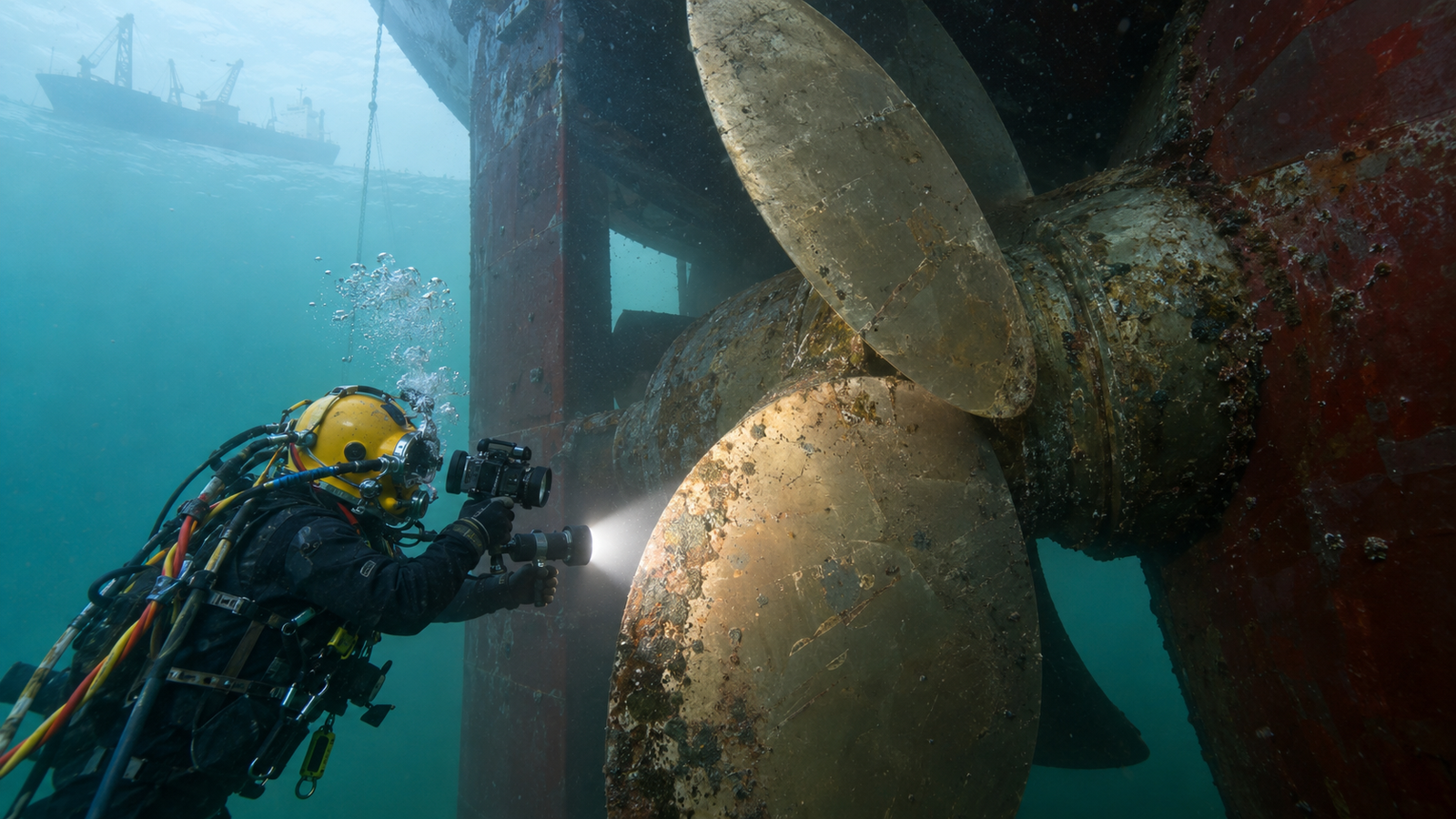
The Propeller Is Critical to Vessel Performance
The engine produces power.
The propeller converts that power into thrust.
Its condition therefore directly matters to the vessel’s propulsion system.
During normal operations, propellers may be exposed to marine growth, cavitation effects, floating debris, ropes, fishing gear and accidental contact with foreign objects.
Without an underwater inspection, some of these conditions may remain unknown.
What Can an Underwater Propeller Inspection Detect?
Professional commercial divers can document visible conditions affecting the propeller and surrounding areas.
Marine Growth. Fouling can develop on propeller surfaces and alter their smoothness.
Blade Damage. Divers can document visible dents, deformation, damaged edges and other abnormalities for evaluation by the vessel’s technical team.
Rope and Fishing-Line Entanglement. Ropes, nets and fishing gear can become wrapped around the propeller or shaft area and require underwater removal.
Surface Condition. Close-up video can document roughness, corrosion, cavitation-related marks and other visible surface conditions.
Hub and Accessible Shaft Areas. Where accessible and within the inspection scope, divers can document the visible condition of the hub and adjacent areas.
Why Consider the Inspection in Panama?
Panama is a major convergence point for international commercial shipping.
For vessels already calling, anchoring or conducting operations in the region, the stop can provide an opportunity to assess underwater components before continuing the voyage.
The Panama Canal Authority operates its own vessel inspection program for vessels within Canal jurisdiction. Since October 1, 2025, the Canal has also operated a risk-based vessel inspection model, with risk assessment considering factors such as vessel type, age, deficiency history, flag state and classification society.
An Aquadiver underwater propeller inspection is a maintenance and condition-assessment service; it should not be confused with the Panama Canal Authority’s official transit inspection.
That distinction is important.
1. Identify Problems While the Vessel Is Already in Panama
If vibration, performance changes or a suspected underwater incident has been reported, an underwater inspection can provide visual information without immediately dry docking the vessel.
2. Detect Entanglement
A rope or fishing net around the propulsion system can sometimes be identified and addressed by professional divers.
3. Evaluate Whether Propeller Polishing Is Appropriate
Inspection can determine whether visible fouling or surface condition warrants further evaluation for propeller polishing.
Rather than polishing automatically, the operator gains information about the actual underwater condition first.
4. Document Visible Damage
High-quality underwater photographs and video provide technical managers with evidence they can review remotely.
This is especially valuable when the superintendent, shipowner or engineering department is located in another country.
5. Combine Inspection With Other Underwater Services
If the vessel requires additional attention, the operation may potentially be coordinated with hull inspection, hull cleaning, sea chest inspection, propeller polishing, rope removal or other underwater services as appropriate.
What Should Divers Examine?
A systematic propeller inspection can document the:
- blade faces;
- blade backs;
- leading edges;
- trailing edges;
- blade tips;
- propeller hub;
- accessible shaft area;
- surrounding underwater components.
The goal is to produce clear visual evidence rather than simply confirm that the propeller “looks good.”
Inspection Before Polishing
Propeller inspection and propeller polishing should be treated as related but different operations.
The inspection determines the visible condition.
Polishing is a maintenance intervention intended to improve the propeller surface condition when appropriate.
This inspection-first approach allows the vessel operator to make a more informed maintenance decision.
Underwater Propeller Inspection After a Suspected Incident
An inspection becomes particularly valuable when a vessel has experienced or suspects:
- contact with floating debris;
- rope entanglement;
- unusual vibration;
- unexplained propulsion changes;
- possible grounding or underwater contact;
- abnormal performance.
In these situations, underwater video can provide technical teams with immediate visual information about accessible components.
Depending on what is found, additional inspection, measurement, repair or class involvement may be necessary.
Why Professional Documentation Matters
For commercial vessels, an underwater inspection is not simply about seeing the propeller.
The information needs to be useful to people making technical decisions.
That means obtaining stable footage, appropriate angles, close-up views of suspicious areas and a systematic record of the inspected components.
Professional documentation allows the vessel’s technical team to evaluate findings and determine the appropriate next step.
Underwater Propeller Inspection Services in Panama
Aquadiver Panama provides underwater propeller inspections for commercial vessels in Panama, helping shipowners, operators and technical managers evaluate the visible condition of propulsion components without immediately removing the vessel from the water.
Depending on vessel requirements, Aquadiver can also provide related commercial diving services including:
- underwater hull inspections;
- underwater hull cleaning;
- propeller polishing;
- underwater cutting and welding;
- salvage diving;
- blanking of overboard sea valves.
Schedule a Propeller Inspection in Panama
A vessel’s propeller may be underwater and out of sight, but its condition should not be left unknown when there is reason to suspect fouling, damage or entanglement.
For commercial ships operating in the Panama region, an underwater inspection can provide valuable information while minimizing disruption to operations.
Contact Aquadiver Panama to schedule a professional underwater propeller inspection in Panama.