
Underwater Cutting and Welding in Panama: When Commercial Vessels Need Underwater Repairs
Unexpected underwater damage does not always occur conveniently near a scheduled dry dock.
Commercial vessels can experience conditions below the waterline that require immediate inspection, temporary intervention or planned underwater repair.
In certain situations, Underwater Cutting and Welding in Panama can provide shipowners and technical managers with another maintenance option while the vessel remains afloat.
These are specialized commercial diving operations requiring trained personnel, appropriate procedures, equipment, risk assessment and coordination with the vessel’s technical team and, where required, classification or regulatory authorities.
Aquadiver Panama provides commercial diving services for vessels requiring underwater inspection, cutting, welding and related underwater operations in the Panama region.
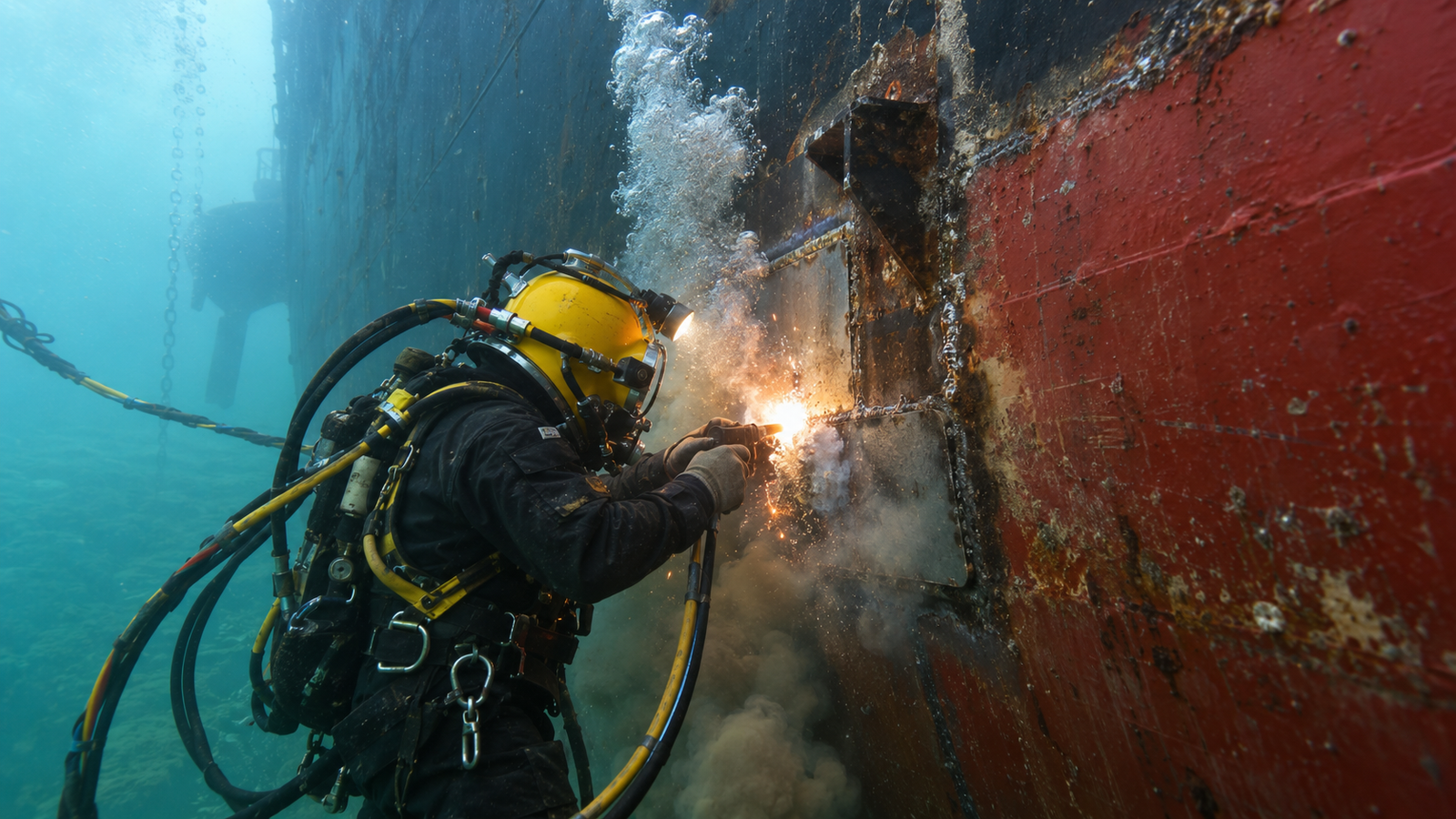
What Is Underwater Welding?
Underwater welding allows qualified commercial divers to perform specific welding operations below the waterline.
Unlike conventional shipyard welding, the operation takes place in a complex underwater environment.
Conditions such as:
- water depth;
- visibility;
- currents;
- material condition;
- access;
- vessel configuration;
- welding position;
- required repair;
- operational conditions
can all influence how the work must be planned.
Underwater welding therefore requires much more than placing welding equipment in the hands of a diver.
Qualification matters. DNV, for example, includes AWS D3.6M and ISO 15618-1 among standards covered by its qualification testing for underwater welders. DNV
What Is Underwater Cutting?
Underwater cutting is used when metal structures or components must be removed, separated or prepared below the waterline.
Possible applications can include:
- removal of damaged material;
- cutting obstructing metal;
- preparation for repair;
- removal of damaged structures;
- salvage operations;
- modification of underwater components.
The appropriate technique depends on the material, location, structural importance and objective of the operation.
When Can Commercial Vessels Require Underwater Repairs?
1. Unexpected Underwater Damage
A vessel may require investigation after suspected contact with:
- floating objects;
- underwater structures;
- debris;
- another vessel;
- seabed or other underwater obstruction.
Inspection should generally come before repair.
Divers can document the affected area so the technical team can determine the next action.
2. Damaged or Loose Components
Underwater appendages or external components may become damaged or loose during operation.
Depending on the component and engineering requirements, an underwater intervention may be considered.
3. Temporary Repairs
Not every underwater repair is intended to become a permanent structural solution.
In certain circumstances, an engineered temporary repair may help stabilize a condition until permanent work can be completed.
The repair method must be determined according to the specific technical requirements of the vessel.
4. Emergency Situations
Commercial vessel schedules leave little room for unexpected damage.
When a condition is discovered below the waterline, rapid underwater inspection can help establish:
What happened?
How extensive is the visible damage?
Can an underwater intervention be considered?
Does the vessel require additional engineering, class involvement or dry docking?
This information can dramatically improve the decision-making process.
Inspection Comes Before Welding
One of the most important principles in underwater repair is understanding the condition before intervening.
The normal sequence should be based around:
Inspect → Document → Evaluate → Plan → Repair → Verify
An underwater inspection can provide video and photographs of the affected area.
Technical personnel can then determine the appropriate repair methodology.
Not Every Damage Should Be Welded Underwater
This distinction is critical.
Underwater welding is not automatically the correct solution simply because damage is accessible to a diver.
The vessel’s structural requirements, location of the damage, material, loading conditions, repair classification and applicable rules must all be considered.
Some repairs may require dry docking.
Others may require engineering calculations.
Some may be suitable only as temporary repairs.
Others may be performed underwater under an approved procedure.
Why Welding Procedures Matter
Professional marine welding depends on controlled procedures.
DNV explains that welding work covered by its requirements must follow Welding Procedure Specifications defining parameters such as materials, welding position, welding parameters and consumables; procedure qualification is part of establishing compliance. DNV
For shipowners, this means the important question is not simply:
“Can someone weld this underwater?”
The correct question is:
“What repair is technically appropriate, and what procedures and approvals are required?”
Underwater Cutting During Salvage Operations
Underwater cutting also plays an important role beyond routine ship repair.
During salvage or recovery operations, divers may need to remove or separate submerged structures to gain access, release equipment or prepare material for recovery.
This makes underwater cutting a complementary capability to professional salvage diving.
Aquadiver’s services in the Panama region include both underwater cutting and welding and salvage diving operations.
The Importance of Documentation
A professional underwater repair operation should provide more than the completed intervention.
Visual documentation can allow technical managers to evaluate:
- original condition;
- damaged area;
- repair preparation;
- repair process where feasible;
- final visible condition.
This information can be particularly important when vessel management personnel are not physically present at the dive location.
Why Panama Matters for Underwater Ship Repair
Panama’s position within international shipping routes means large numbers of commercial vessels operate through the region.
When underwater problems are identified during operations in Panama, access to commercial diving capability can allow operators to investigate the condition without automatically assuming that immediate dry docking is the only available first step.
The inspection establishes the facts.
The technical team then determines the appropriate solution.
Underwater Repair vs. Dry Dock
These should not be viewed as competing solutions.
Dry docking remains necessary for many types of repair and survey work.
Underwater repair provides an additional capability for circumstances where work can technically and safely be performed while the vessel remains afloat.
The decision depends on the damage, engineering requirements, class requirements, vessel condition and repair objectives.
Commercial Diving Services in Panama
Aquadiver Panama provides professional underwater services for commercial vessels, including:
- Underwater Inspections
- Underwater Hull Cleaning
- Propeller Polishing
- Underwater Cutting & Welding
- Salvage Diving Panama Region
- Blanking of Overboard Sea Valves
These capabilities allow vessel operators to coordinate multiple underwater requirements through a commercial diving operation in Panama.
Need an Underwater Repair in Panama?
When underwater damage is suspected, the first priority is understanding exactly what happened below the waterline.
Professional inspection can document the problem.
Qualified technical personnel can then determine whether underwater cutting, welding, another intervention or dry docking is appropriate.
Contact Aquadiver Panama for professional Underwater Cutting, Underwater Welding and Commercial Diving Services in Panama.