
How Underwater Hull Cleaning Helps Commercial Vessels Improve Operational Efficiency in Panama
For commercial vessels, what happens below the waterline can directly affect operational performance.
As a vessel operates, marine organisms begin accumulating on submerged surfaces. Over time, this biofouling can create additional surface roughness and resistance as the vessel moves through the water.
The result can be greater hydrodynamic drag and deterioration in the relationship between vessel speed, required power and fuel consumption.
This is why Underwater Hull Cleaning in Panama can become an important part of a commercial vessel’s maintenance strategy.
Aquadiver Panama provides professional underwater hull cleaning services for commercial vessels operating in the Panama region, allowing operators to address marine growth while the vessel remains afloat.
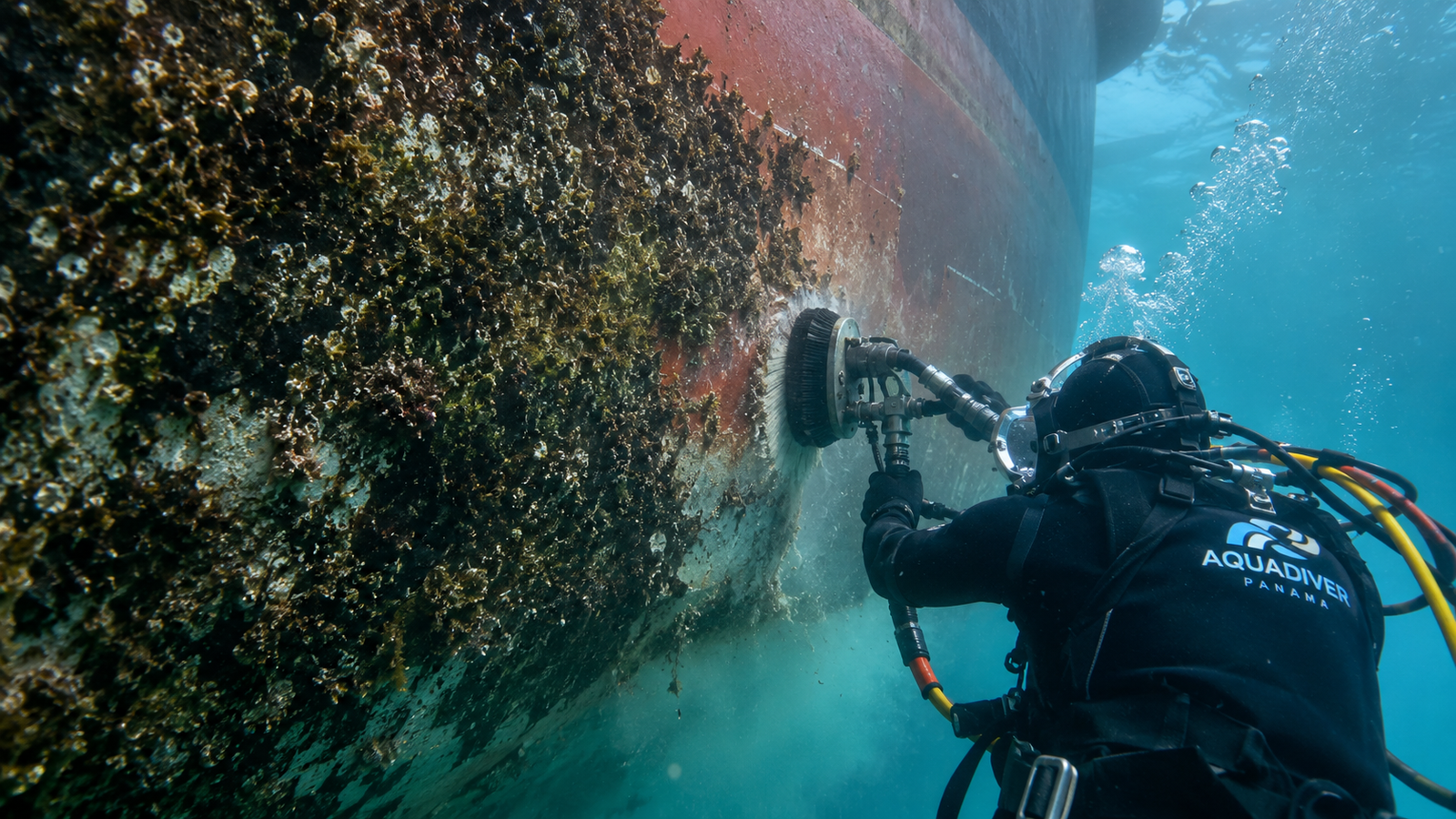
What Is Biofouling?
Biofouling is the accumulation of aquatic organisms on surfaces that remain immersed in water.
It can include:
- slime and biofilm;
- algae;
- barnacles;
- tubeworms;
- shell growth;
- other marine organisms.
Biofouling does not suddenly appear when a vessel becomes heavily fouled.
The process begins much earlier.
The International Maritime Organization notes that biofouling can begin within the first hours of a ship being immersed, although its subsequent development varies according to vessel design, operating profile, trading routes, environmental conditions and maintenance history. Organización Marítima Internacional
Why Does Hull Fouling Matter?
A clean hull moves through water differently from a hull covered with marine growth.
As surface roughness increases, resistance can increase as well.
This means the propulsion system may need to work harder to maintain a given operating condition.
IMO’s GreenVoyage2050 program identifies hull fouling as detrimental to hydrodynamic performance and to the relationship between speed, power and fuel consumption. greenvoyage2050.imo.org
For commercial operators, this makes hull condition an operational issue—not simply a cosmetic one.
1. Increased Hydrodynamic Resistance
The underwater hull represents an enormous surface moving continuously through water.
When that surface becomes rough due to biological growth, drag can increase.
The more severe the fouling, the greater the potential impact on vessel performance.
2. Fuel and Energy Efficiency
Increased resistance can translate into greater power requirements.
IMO recognizes biofouling management as a tool that can improve hydrodynamic performance and contribute to improved ship energy efficiency. Organización Marítima Internacional
The exact impact on an individual vessel depends on factors including hull condition, fouling severity, vessel type, operating speed and operating profile.
For that reason, operators should avoid assuming a universal percentage saving from every cleaning operation.
3. Speed and Power Performance
Biofouling can affect the relationship between speed and required propulsion power.
A vessel experiencing deterioration in performance may therefore benefit from evaluating the condition of its underwater hull as part of the investigation.
Hull condition is only one possible factor, but it is one that can be visually inspected.
4. Biofouling in Niche Areas
Fouling is not limited to large flat sections of hull plating.
Marine growth can also develop around:
- sea chests;
- gratings;
- rudders;
- thrusters;
- propellers;
- bilge keels;
- underwater appendages.
These areas may require particular attention during inspection and maintenance.
Why Inspect Before Cleaning?
Underwater hull cleaning should not automatically begin simply because some marine growth is visible.
A professional underwater inspection can first help determine:
- type of fouling;
- severity of growth;
- areas affected;
- apparent coating condition;
- condition of niche areas;
- whether additional underwater components require attention.
This provides technical managers with visual information before deciding the appropriate maintenance action.
How Is Underwater Hull Cleaning Performed?
Depending on vessel condition, fouling type, coating requirements, environmental restrictions and the approved cleaning method, professional divers or specialized equipment can remove marine growth from submerged hull surfaces.
The objective is to remove unwanted fouling while controlling the cleaning process and avoiding unnecessary damage to the vessel’s coating.
This is particularly important because aggressive cleaning can affect anti-fouling coatings.
IMO’s current guidance recognizes both the value of in-water cleaning and the need to address potential risks to coatings and the marine environment. In April 2025, MEPC approved specific guidance on in-water cleaning of ships’ biofouling. Organización Marítima Internacional
Environmental Considerations
Underwater hull cleaning cannot be treated as the same operation everywhere.
Local restrictions may apply because cleaning can release biological material, coating residues or other substances into surrounding waters.
IMO specifically notes that hull cleaning is prohibited or restricted in many ports because of contamination and invasive-species concerns. greenvoyage2050.imo.org
Before performing an operation, applicable local requirements and environmental restrictions should therefore be confirmed.
Why Panama Is a Strategic Location for Hull Cleaning
Panama is positioned along one of the world’s most important commercial shipping routes.
Commercial vessels regularly operate, anchor, wait, load, unload or conduct maintenance activities in the region.
For vessels already stopping in Panama, underwater maintenance can potentially be coordinated with the vessel’s operational schedule.
Rather than repositioning a vessel solely for an underwater inspection or maintenance activity, operators may be able to use an existing operational window.
Hull Cleaning and Propeller Polishing
Hull condition is only part of underwater hydrodynamic performance.
The propeller is another critical component.
When appropriate, an underwater operation can combine:
Hull Inspection → Hull Cleaning → Propeller Inspection → Propeller Polishing
This gives technical managers a broader view of the vessel’s underwater condition.
When Should a Commercial Vessel Consider Hull Cleaning?
There is no single cleaning interval appropriate for every vessel.
An inspection may be appropriate when there is:
- visible or suspected marine growth;
- extended idle or anchorage periods;
- deterioration in speed-power performance;
- an upcoming operational requirement;
- evidence of fouling in niche areas;
- a need to evaluate underwater condition between dry docks.
Maintenance decisions should consider the vessel’s coating, fouling condition, operating profile and applicable environmental requirements.
Professional Underwater Hull Cleaning in Panama
Aquadiver Panama provides Underwater Hull Cleaning in Panama for commercial vessels, helping operators inspect and maintain submerged hull surfaces while minimizing unnecessary operational disruption.
Related services include:
- Underwater Inspections
- Propeller Polishing
- Underwater Cutting & Welding
- Salvage Diving
- Blanking of Overboard Sea Valves
Schedule Underwater Hull Cleaning in Panama
Biofouling develops where the vessel’s technical team cannot normally see it.
Professional underwater inspection and cleaning provide an opportunity to evaluate and address those conditions while the vessel remains afloat.
Contact Aquadiver Panama for professional Underwater Hull Cleaning and Commercial Diving Services in Panama.