
How Class Approved Underwater Surveys Can Reduce Dry Dock Costs for Commercial Vessels
For shipowners and technical managers, dry docking is one of the most significant maintenance events in a vessel’s operational cycle.
It can involve yard costs, scheduling constraints, operational downtime, repositioning and extensive planning.
In certain circumstances, however, an approved underwater survey may allow specific bottom survey requirements to be completed while the vessel remains afloat.
For commercial vessels operating in one of the world’s most important maritime hubs, Class Approved Underwater Surveys in Panama can therefore become an important component of a proactive vessel maintenance strategy.
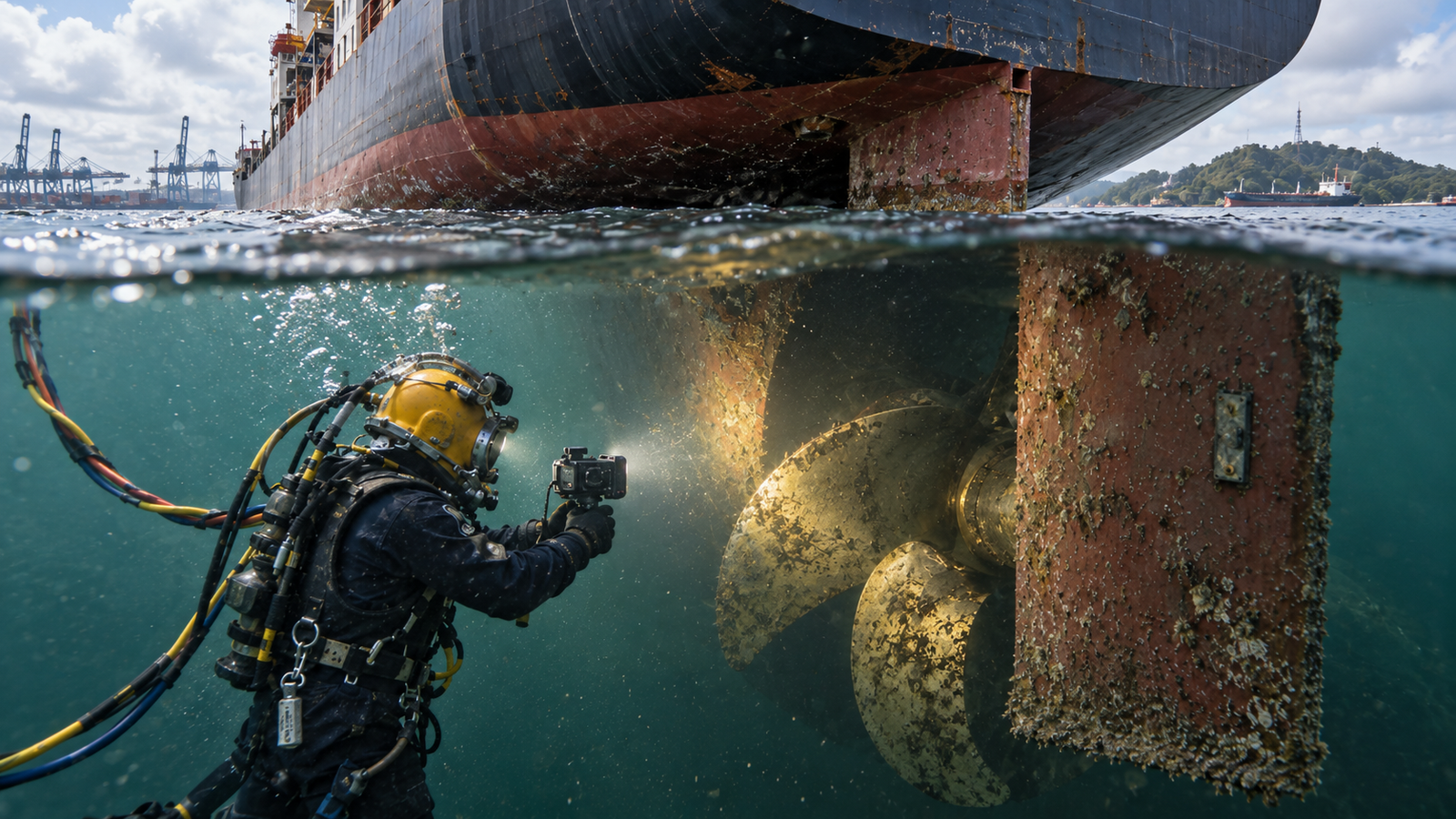
Aquadiver Panama provides professional underwater inspection services for commercial vessels, documenting the condition of critical underwater components and supporting inspections performed according to the requirements established for each operation.
What Is a Class Approved Underwater Survey?
A class approved underwater survey is a structured inspection of the submerged areas of a vessel conducted according to requirements established by the vessel’s classification society and, where applicable, the relevant flag administration.
Depending on the vessel, survey program and approval, an in-water bottom survey may be accepted instead of a conventional dry-dock bottom survey.
The objective is not simply to send a diver underwater and record video.
The inspection must provide clear and systematic evidence of the condition of the vessel’s underwater structure and relevant components.
This distinction is important.
A routine underwater inspection can help a shipowner understand the condition of a vessel.
A Class Approved Underwater Survey must follow the applicable procedures, documentation requirements and supervision established for the particular vessel and survey.
Why In-Water Surveys Matter to Commercial Ship Operators
Taking a commercial vessel out of service has consequences beyond the cost of the shipyard itself.
A dry-docking operation can involve:
- loss of operational availability;
- shipyard and docking expenses;
- repositioning costs;
- additional logistical requirements;
- coordination with classification societies and contractors;
- potential disruption to commercial schedules.
Where an in-water survey is permitted, inspecting the vessel while afloat can reduce some of these operational impacts.
This is why underwater inspection capabilities are becoming an increasingly valuable part of modern vessel maintenance planning.
What Can Be Inspected Underwater?
The exact scope depends on the vessel and the requirements established for the survey, but an underwater inspection may include areas such as:
Hull Plating
Divers visually inspect accessible areas of the underwater hull for evidence of:
- coating deterioration;
- corrosion;
- deformation;
- impact damage;
- cracks or other visible abnormalities;
- marine growth affecting inspection visibility.
Propeller
The propeller is one of the most important components of the vessel’s propulsion system.
An underwater inspection can identify visible indications of:
- blade damage;
- edge deformation;
- surface deterioration;
- marine fouling;
- rope or fishing-line entanglement;
- cavitation-related surface damage.
Rudder and Steering Components
The inspection can document the visible condition of the rudder, accessible clearances and surrounding components.
Any abnormal condition can then be reported for further technical evaluation.
Sea Chests and Gratings
Marine growth or debris around sea chest gratings can interfere with seawater flow.
An underwater inspection allows the condition of these areas to be documented without waiting until the next scheduled dry docking.
Thrusters
Bow and stern thrusters can also be visually examined for fouling, damage, obstructions or other visible abnormalities.
Anodes
Sacrificial anodes provide an important visual indication of the condition of the vessel’s cathodic protection system.
Divers can document their apparent condition and remaining material for evaluation by the vessel’s technical team.
How Underwater Surveys Can Help Reduce Dry Dock Costs
The financial value of underwater inspections is not limited to replacing a dry-dock inspection where permitted.
They can also help shipowners prepare more effectively for future maintenance.
1. Detect Problems Before Dry Dock
Finding damage before the vessel enters a shipyard gives the technical team more time to evaluate the problem and prepare the required work.
Instead of discovering an unexpected defect after docking, the operator may already know what requires attention.
2. Improve Repair Planning
Detailed underwater video and photographs can help technical departments determine which areas require closer examination or repair.
This can improve preparation for the next scheduled docking.
3. Reduce Unexpected Maintenance
A vessel that is periodically inspected underwater provides technical managers with more information about its actual condition.
This can reduce uncertainty when planning maintenance budgets and future interventions.
4. Combine Multiple Underwater Services
When conditions permit, an inspection can be coordinated with other underwater operations such as:
- hull cleaning;
- propeller polishing;
- sea chest cleaning;
- removal of rope or fishing line;
- underwater repairs;
- blanking of overboard sea valves.
Combining operations can reduce repeated mobilization and improve maintenance efficiency.
Class Approval Is Not Automatic
An important distinction for shipowners is that an underwater inspection does not automatically replace dry docking.
Eligibility depends on factors including the vessel, applicable class rules, flag requirements, survey status, vessel condition and the specific inspection program.
The classification society should therefore be involved in determining the required scope and whether an in-water survey is acceptable.
Professional commercial diving companies must be capable of following the required inspection procedures and producing clear visual documentation for technical review.
Why Panama Is a Strategic Location for Underwater Ship Inspections
Panama occupies a unique position in global maritime transportation.
Commercial vessels operating through the region may call at ports, anchorages and terminals on both the Pacific and Atlantic sides.
This creates an opportunity for shipowners to coordinate underwater maintenance while the vessel is already operating in the region.
Rather than waiting for a problem to develop into a larger maintenance requirement, operators can use a scheduled stop in Panama to evaluate the vessel’s underwater condition.
Underwater Inspection as Preventive Maintenance
The greatest value of an underwater inspection is often information.
Technical managers cannot directly observe most submerged components during normal vessel operations.
Professional underwater inspections provide visual evidence that can help answer important questions:
What is the actual condition of the hull?
Is the propeller damaged or fouled?
Are sea chest gratings obstructed?
Are the anodes showing significant depletion?
Is there visible damage to the rudder or other underwater appendages?
The earlier these questions are answered, the more options the vessel operator has.
Professional Underwater Inspections in Panama
Aquadiver Panama provides professional underwater inspection services in Panama for commercial vessels, supporting shipowners, vessel operators, technical managers and maritime companies requiring reliable information about their vessel’s underwater condition.
Operations can include underwater video and photographic documentation of hull plating, propellers, rudders, sea chests, thrusters, anodes and other accessible underwater components.
When an inspection is related to classification requirements, the scope should always be coordinated according to the applicable class and flag requirements.
Schedule an Underwater Survey in Panama
If your vessel is scheduled to call at Panama and requires an underwater inspection, planning the operation in advance can help minimize disruption to the vessel’s schedule.
Contact Aquadiver Panama for professional underwater inspections and commercial diving services in Panama.